
5 Minutes That Matter
Just 5–10 minutes of focused learning daily can significantly improve a child's number recognition and listening skills...
ChemCheemi started from the real-life struggle of a new parent in town (Our Founder — Eng. Kelvin Paul) raising a child who had smartphone and TV addiction by just age 3.
"The inception of the idea emerged as a home Do-It-Yourself (DIY) project aimed at replacing a perplexing toy and curing screen time addiction for my son. Being new to parenthood, I had 3 weeks alone with my son at home, and that's when I first observed the challenge of raising a child in this fast-growing technology... Then I made the first audio learning system for him. After a great reaction from the boy, the initial assessment involved a test at his school, where his friends were invited to participate on his birthday. The presence of Early Childhood Education teachers during the trial sparked their enthusiasm, inspiring me to envision the potential of extending this project to benefit children across Tanzania and beyond."
And the rest is every team member's story, every parent's or guardian's story, every stakeholder’s story, and the most important, every Child’s story. We are all Chemians, #ChemCheemiNdiyoSisi
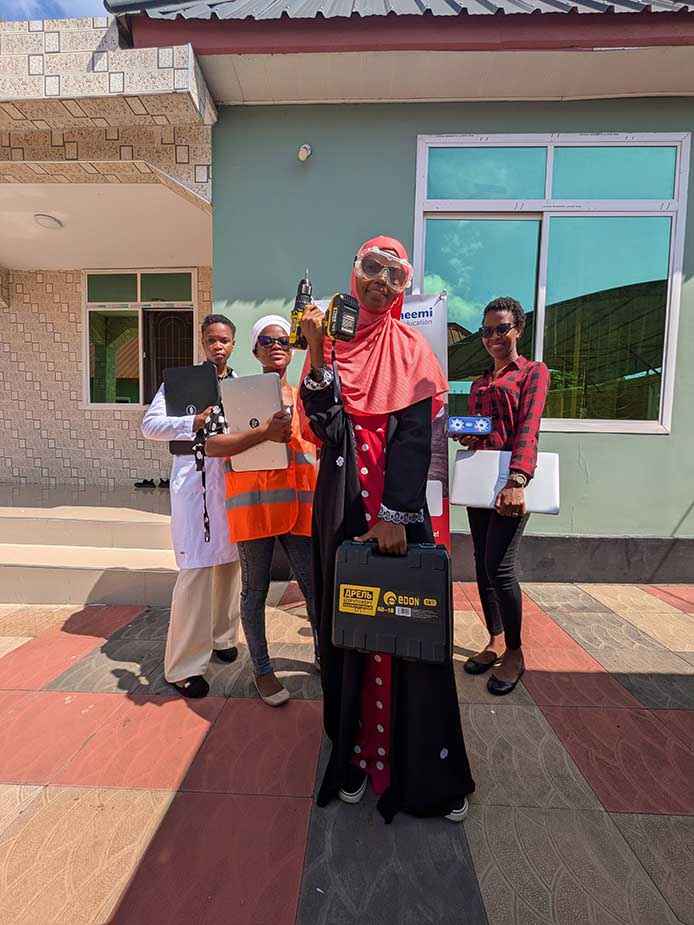
From concept to first prototype
Testing, learning, proving what works
Scaling reach, deeper community impact

Across Tanzania, many children are struggling to build strong Mathematics and Literacy foundations. Large class sizes, limited learning resources, and increasing smartphone and TV exposure make it harder for parents and teachers to keep children engaged in meaningful learning. As a result, many learners fall behind in reading, counting, and problem-solving — contributing to rising learning poverty. At the same time, millions of Tanzanian parents are searching for healthier alternatives to screens. Without the right tools, children often spend more time consuming passive entertainment than developing essential skills.
That is why ChemCheemi exists. Unlike costly or internet-dependent solutions, ChemCheemi is an Afro-centered, screen-free learning system designed to grow with children aged 3–14 years — helping them strengthen numeracy, literacy, and critical thinking through play, sound, and interaction.
ChemCheemi Africa is a Tanzanian EdTech company building Afro-centered, screen-free learning solutions for children.
We help families reduce screen time by providing a smart learning device that:
ChemCheemi Africa focuses on designing, developing, and distributing smart and interactive learning systems that combine IoT technology with gamified learning.
Our goal is to give African children access to offline, personalized learning-through-play experiences that build strong foundations in Mathematics, Literacy, STEM, and Social skills.

To develop and distribute inclusive, affordable, and interactive learning solutions that empower African children with literacy, numeracy, STEM, and Social skills while promoting their cognitive, linguistic, and motor development.
Transforming education by providing the best healthy learning experiences for African children.
Making an impact across Tanzania
The amazing team of ChemCheemi

CEO & Founder

CCO

Content Development Officer

Sales and Marketing Officer

Head of Systems
We are not alone — we are deeply grateful for all the support we receive from partners, schools, parents, and the community!
Thank you for believing in #ChemCheemiNdiyoSisi








Welcome to The TapCorner – where we share ChemCheemi's latest milestones, parenting tips, and powerful stories from kids, parents, and teachers across Tanzania.
 TapTips 3 min read
 Just 5–10 minutes of focused learning daily can significantly improve a child's number recognition and listening skills...
Just 5–10 minutes of focused learning daily can significantly improve a child's number recognition and listening skills.
"Instead of giving your child a phone while you cook or work, try this:"
Small, consistent habits build big results.Tap. Listen. Grow.
 TapTips | TapParents 10 min read
 By Eng. Kelvin Paul - Founder of ChemCheemi. "The era for 'best grades' is over. It's 4 C's time. Education can be seen as a business, just like any other business. The smartest way to convert customers would be to tell them that after eating the food, they will be healthy..."
Education can be seen as a business, just like any other business. For example, a food catering business would have a mission, vision, motto, spirit, or slogan that would be used in different marketing materials and platforms to attract customers and generate leads.
The smartest way to convert customers would be to tell them that after eating the food, they will be healthy. You may be telling them that you are selling good bread, but people will buy your advertisement message if it tells that the bread will improve their morning, make their family happy and united, and finally healthy. It is a fact that people are known to buy the best version of themselves or change after using your product.
Now back to the schools, what is the education's unique value proposition? What is the product? What is it being sold?
There are school operations, there are school values, there is school vision, mission, motto, or spirit. Government schools have their motto types, like at ChemChem Primary School we had "Elimu ni Uhai wa Jamii", something to remind the society that without education they will never accomplish anything if not extinct.
But a private school will have something to remind the parent (buyer) that his/her child will be employable or academically amazing (Division One, two, get enrolled to advanced level, secure great scholarships, etc). You see, they also don't talk about the subjects, the homework, or the quizzes, just after meeting the new customer, but they talk much about the final version of the consumer after using the product/service.
Therefore, the final version of the student as the primary consumer of the educational service from any school has mostly been the "easily employable young person". And to achieve that every school is working hard to make sure the students graduate with the best grades, thinking that is what guarantees employability. It worked before, but does it still work?
It's not that employers reject graduates with the best grades, No. The challenge is having only that. You see, a graduate with the best grades is somehow in a good position to pass through the first gate of the employment process (filtering). But the chances of getting a job are very narrow if that is the only thing a job seeker can offer.
Also, that may not be the only problem; the other big problem is how many chances are available out there for the best students to show their colorful transcripts and certificates. How many jobs?
On average, the Tanzanian economy creates about 250,000 jobs a year.
Despite some 800,000 to 1,000,000 graduates entering the labor market in Tanzania every year, most graduates take about 5.5 years to secure a wage job.
Then the option remaining for the graduates to strive doesn't require colorful grades but critical thinking, communication skills, collaboration, and creativity. These are the 4 C's of education in this evolving 21st-century education.
All these can not easily be attained with most of the current schools' teaching systems. A system that still thinks a well-planned STEAM Maker program in school is a time-consuming luxury and it should be parents' worry, but extra learning hours on weekends and holidays are worth it for students to be well prepared for the final examination.
The 4 C's are the only hope for the students to strive not only in their future complex work but also the social structures. The future and emerging mothers, fathers, and guardians, the customers of the private schools will be much more aware of these and will demand a school's insurance with a plan that their kids will graduate with not only best-graded certificates but also colorful 4 C's. That will change the whole marketing approach of the schools.
There was a time when education was every parent's phobia. Schools had only to say that the school is well registered, and boom, it gets the customers. Parents had money/others fought hard but were uneducated and saw their fellow educated friends being respected, bombarded with proximity sensor-based doors of opportunities, and the stories of being offered a job while finalizing their studies. Parents respected the education realm. That generation of parents (customers) is phasing out rapidly.
Yes, the current and future parents are the ones who have seen their close ones with the best grades suffer to get a job if not themselves. This is the time for parents to see people with talents running the show.
These are times when the parents witness that grades are no longer essential to survive, but skills. Skills that can not be taught the same way as before. The values to sell to these customers must change from employed graduates to skilled/innovative/entrepreneurs.
The school owners who see that early are safe in the future of education.
The time of marketing your school as the best producer of job seekers is over; it is the time for marketing your school as the best producer of job creators.
I think now is the time to do more than end up with ICT4E teachers' capacity-building events, using ICT to run your school. That is, of course, one way of leveraging technology to revolutionize the education sector, but customers need, first, the value they pay for.
It's like being busy improving the ingredients mixing machines, buying sophisticated financial, accounting, and HR systems to manage your employees, and yes, the factory really looks modern, but using an outdated/bad recipe will never get you new customers to buy your food.
Empower your teachers with competency-based learning and teaching tools from innovators like MITz Kits, Smart Darasa, and other local innovators. The local innovators give you a chance to easily collaborate with them for more consultations, and also you make students believe it's possible when they see the tools from the people they know/hear about, or can easily reach out to.
Equip your computer lab with proper programs. If you have a library or laboratory, add the maker space. Emphasize the innovation sensitization programs. Go out and seek partnerships with third-party experts like MITz Kits, Project Inspire, and Taifa Hub to bring new skills and experience to your employees.
Create an active community of alumni and other experts from different domains like entrepreneurship, business leadership, engineering, the health sector, the education sector, and others. Create an annual plan for them to engage with students, even virtually (technology can offer you that). Use it to inspire and motivate your kids. Be close to what is going on in the world, rather than hiding in your school, trying to pressure every teacher to finish the syllabus.
Create a pipeline of opportunities for your kids, starting from domestic to global, like MAKISATU, @ProjektInspire boot camps, Technovation, and others. These will bring to students not only a chance to explore their potential but also a stage for a school to market its value. Don't end up sending and allowing students to participate with tight conditions; you can look for partnerships and create a long-lasting relationship with those initiatives.
Finally, I advise schools to start thinking about having a person special for working and advising on the innovation and educational technology strategy of the school to stay relevant and ahead of the competition. A school may have a full-time employed expert or outsource a part-time consultant for that.
It's about skills, creativity, and innovation.
Let's prepare our children for that future, today.
 TapNews | TapStories 5 min read
 ChemCheemi recently received national attention after being featured on UTV, part of the Azam TV network. Founder Kelvin Paul shared the vision behind the innovation and how it's helping children aged 3–14 build strong foundations in mathematics through play...
ChemCheemi recently received national attention after being featured on UTV, part of the Azam TV network.
The feature highlighted how ChemCheemi uses game-based learning to make subjects like mathematics fun and engaging. By tapping special learning cards on the ChemCheemi device, children can listen to stories, songs, and interactive activities that encourage curiosity and problem-solving.
Another important message shared during the interview was the growing challenge of smartphone and TV addiction among children.
✓ ChemCheemi offers parents a healthy alternative by providing a screen-free learning experience that keeps children engaged while improving their numeracy and literacy skills.
✓ The interview encouraged parents to invest in tools that balance entertainment with meaningful learning, helping children develop strong skills while building healthier digital habits.
Being featured on national television marks an important milestone for ChemCheemi as more families and schools across Tanzania discover the power of learning through play, sound, and interaction.
 TapTeachers 6 min read
 "Growing up, we encounter teachers at home and in schools, each influencing us uniquely. They may not always wield chalk or red pens, but their impact is profound. For me, my first lesson in mathematics wasn't in a classroom, but at Uyole Market..."
Growing up, we encounter teachers at home and in schools, each influencing us uniquely. They may not always wield chalk or red pens, but their impact is profound.
For me, my first lesson in mathematics wasn't in a classroom, but at Uyole Market, where I helped my uncle, China, sell sugarcane. Without realizing it, he taught me multiplication, negative and positive numbers, long before I ever stepped into a first-grade class.
I sold sugarcane at 25Tsh each, and when a customer bought 90 pieces, my uncle taught me to group them into fours to make a total price of 100 Tsh.
I'd loudly count, "Mia, mia mbili, mia tatu..." because I knew that four pieces equaled 100 Tsh.
By breaking the sugarcane into groups of four, I was essentially counting in hundreds, practicing addition and multiplication at the same time. This method sped up customer service, and my uncle was impressed, thinking I was "sharp."
It wasn't until I started school that I realized how easy math was for me. My teachers had a much easier job reinforcing what I'd learned, and I soon found myself helping my classmates grasp the concepts. My uncle unknowingly laid the foundation for my mathematical skills.
On this World Teachers' Day, I remember him first, along with the great teachers who shaped my journey:
Happy Teachers' Day to all of them!
The point of sharing this story is to highlight that education comes from all directions. Some teach with books, lesson plans, and formal settings, while others impart wisdom in informal places—like markets, with nothing more than a simple ledger.
Teachers have inspired me throughout my life, which is why, despite finishing a degree in engineering, I find myself immersed in educational entrepreneurship. I love empowering educators, supporting their work, and complementing their efforts to inspire others.
What began as a DIY project to fight screen addiction for my son has evolved into ChemCheemi Africa, a venture deeply rooted in my personal journey.
Our initiative draws inspiration from learning through simple, playful methods at home. Together with teachers, we create culturally relevant content and games that reflect the Tanzanian curriculum. Teachers remain our backbone!
Once again, Happy World Teachers' Dayto all the wonderful teachers out there!
 TapParents 3 min read
 Mr. Kassian noticed something surprising. One evening, his children were so engaged with ChemCheemi's story card that they forgot to ask for his smartphone — something that used to happen every night. Instead of scrolling videos, they were counting, listening, and laughing...
Mr. Kassian noticed something surprising.
One evening, his children were so engaged with ChemCheemi's story card that they forgot to ask for his smartphone — something that used to happen every night.
He smiled and said,
"This is the first time learning has defeated the phone."When children are engaged with meaningful, interactive learning, they don't miss the screens. ChemCheemi offers a healthy alternative that entertains while it educates.